Graph Force Layout
Force-directed graph layout from a list of node connections.
Overview
The script takes a list of node connections and produces a force-directed layout of the corresponding graph. Nodes are placed at random initial positions and moved at each time step by the net force acting on them, settling over time into a spread-out, readable configuration.
Forces
Three forces act on each node at every step.
A centring force pulls every node weakly toward the origin, preventing the graph from drifting off-screen. A repulsion pushes every pair of nodes apart with magnitude proportional to $1/d^2$, so nearby nodes repel strongly regardless of whether they are connected. A spring force acts only along edges: connected nodes attract each other when their separation exceeds a target length $\ell$ and repel when it falls short, pulling linked pairs toward a consistent spacing.
At each step, velocity is updated with a damping factor of $0.9$ so the system can settle rather than oscillate indefinitely.
Results
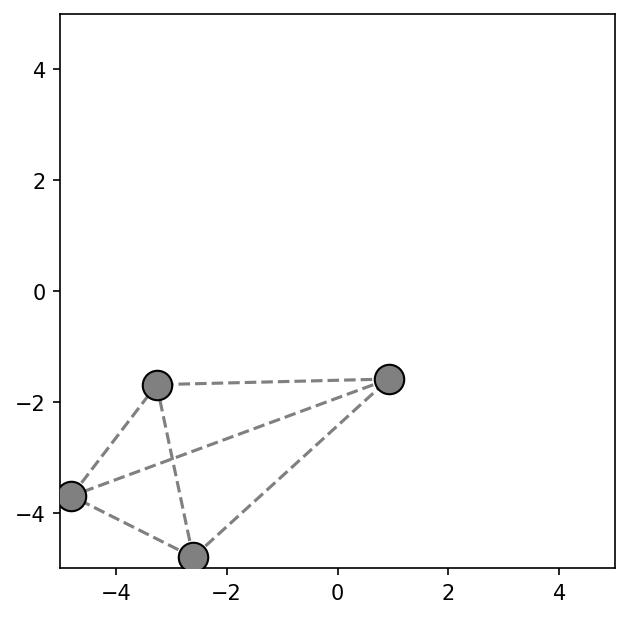
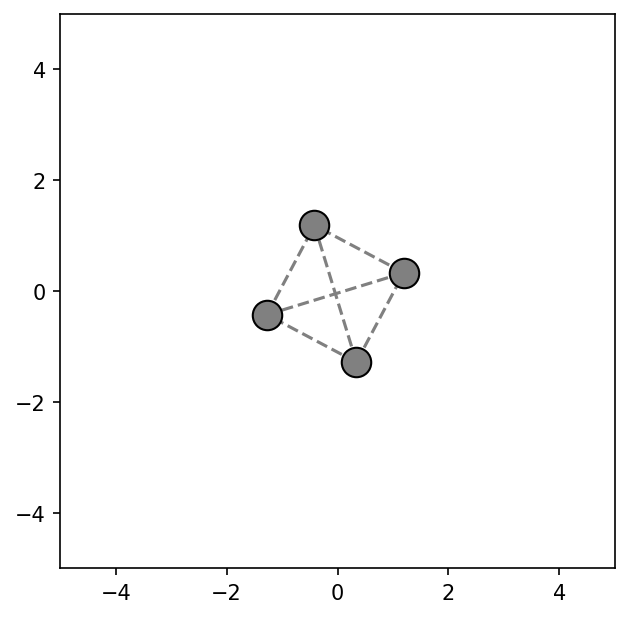
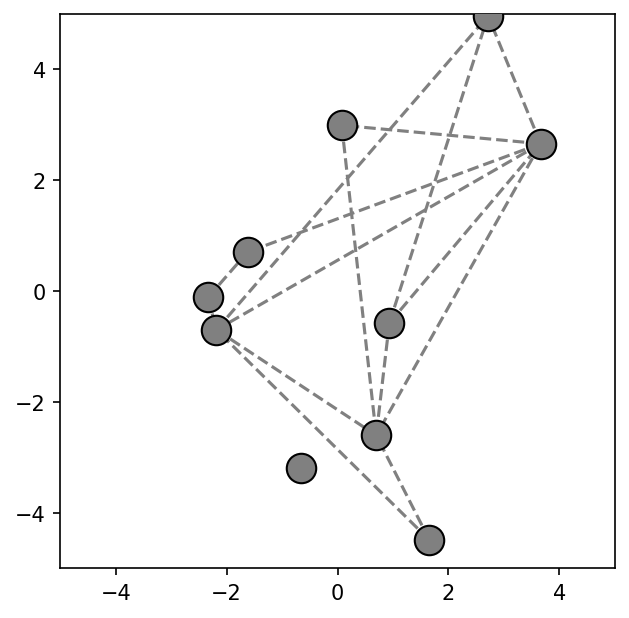
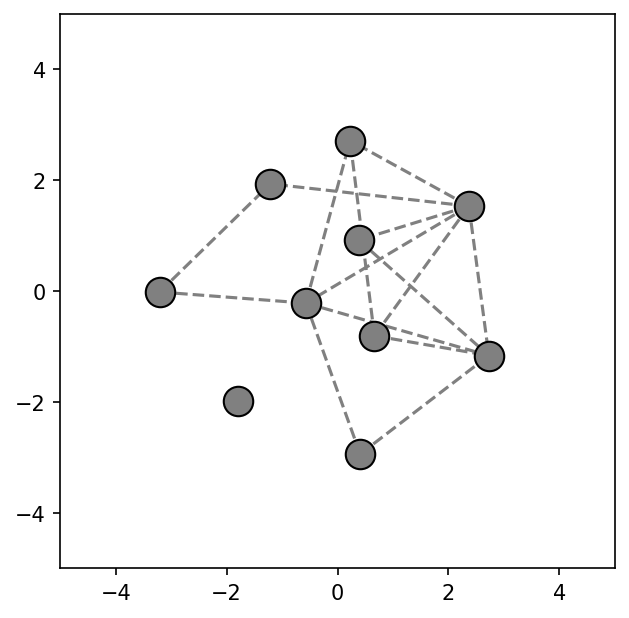
The figures below show the initial and settled layouts for a 4-node and a 10-node graph. In both cases the nodes start in an uneven layout; the forces settle them into a more readable arrangement centred on the origin.
Implementation
The full script is on the linked GitHub. Below is the force calculation and the per-frame update loop.
def calc_force(self, other):
    force_x, force_y = 0.0, 0.0
    epsilon = 1e-5

    # centering
    force_x += (centerx - self.x) * center_force
    force_y += (centery - self.y) * center_force

    if self.index == other.index:
        return force_x, force_y

    dx = self.x - other.x
    dy = self.y - other.y
    distance = np.hypot(dx, dy) + epsilon

    # repulsion
    repel_magnitude = repel_force / (distance ** 2)
    force_x += (dx / distance) * repel_magnitude
    force_y += (dy / distance) * repel_magnitude

    # spring attraction along edges
    is_connected = (
        [self.index, other.index] in connections or
        [other.index, self.index] in connections
    )
    if is_connected:
        displacement = distance - link_length
        spring_magnitude = link_force * displacement
        force_x -= dx * spring_magnitude
        force_y -= dy * spring_magnitude

    return [force_x, force_y]


def update(frame):
    for node in nodes:
        fx, fy = 0.0, 0.0
        for other in nodes:
            dfx, dfy = node.calc_force(other)
            fx += dfx
            fy += dfy
        node.move([fx, fy])